

Remember, at the beginning of the pandemic, when government officials were telling everybody not to buy masks? Toilet paper you could stock up on, but masks were needed for medical personnel. So our health authorities told the public that we didn’t really need them.
Besides, as certain pundits pointed out, non-medical people didn’t really know how to wear masks properly, so they were not useful for everyday wear.
This was a fair point—surgeons and nurses are trained in the rituals necessary to prevent germ transmission. A mask must be donned properly, with freshly washed hands, and taken off correctly as well, folded in on itself so as not to spread the germs that have collected inside it, and then carefully disposed of as hazardous waste.
But since supply was low and demand was high, masks became big business. Smart entrepreneurs rushed to make them. And as soon as supplies caught up, our government authorities shifted their messaging 180 degrees.
Suddenly they were not only advising us all to wear masks but requiring masks in many indoor and even outdoor spaces.
With exactly no science to back up their claims and with public figures simultaneously not wearing them or wearing them incorrectly, Public Health told us that ordinary people wearing masks was extremely effective in preventing transmission of COVID-19.
Hardly plausible for masks to be effective
Almost everyone I knew in our small town in southern Oregon happily rode the mask train. Many could be seen wearing two or even three masks at a time. They drove alone in their cars with a mask on their face and another dangling from the rearview mirror.
No one seemed to notice that there were no standard recommendations about the material your mask should be made from, what grade it should be, or how to wear it correctly.
Men with enormous beards put masks over their voluminous facial hair.
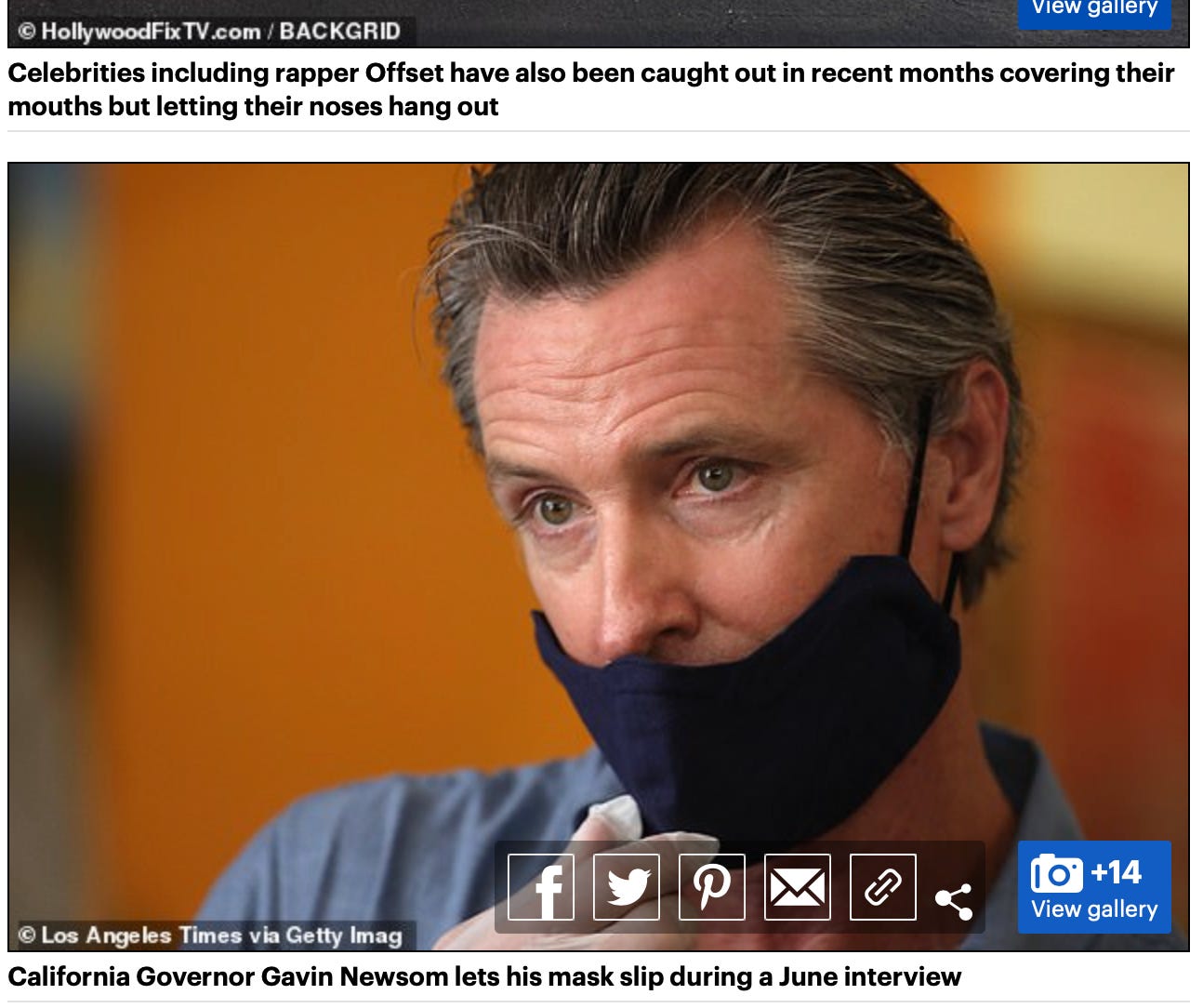
Gavin Newsom, the governor of California, wore his mask under his nose.
A friend of mine worked as a teacher’s aide with small children. She told me her kindergarteners chewed on their masks, spit in their masks, and even vomited in them.
One waitress I encountered in a restaurant in Oregon had a very fashionable mask. She looked good. It was made of … wait for it … rhinestones.
In the cold you could see people’s breath escape from their masks.
But the safety, efficacy, and necessity of these masks was not up for public debate. Instead, anyone questioning the need for masks was summarily silenced. All that mattered was compliance. Wear a mask and you “care about others.” Advocate for free faces and you were “selfish,” “dangerous,” and likely a rightwing fanatic.
That was the public narrative peddled by our public health authorities. Still, thinking people realized very quickly that, given the lack of quality control, it was hardly plausible for masks to be effective in preventing the spread of COVID-19.
Still, otherwise intelligent people were so effectively terrified that they lost the ability to think, absolutely certain that masking was a life-saving activity and completely terrified of anyone who could not or did not wear a mask.
Deluging people with death and panic every hour of the day can do that to you.
These people—perhaps the majority of Americans—were viscerally afraid of anyone not wearing a mask. So much so that they flinched away in terror when they saw a naked face, even out of doors, even if the person they were looking at was more than six feet away.
Something to hide behind
These masks served—and continue to serve—many functions unrelated to slowing transmission of a viral infection.
During the height of the coronavirus craziness people were afraid to go into public spaces. Their masks served as a psychological barrier for them, protecting them from others. The masks created a safe, private space for people to hide inside, a layer of perceived protection to reassure them that the virus would not hurt them.
When a human is afraid, they feel out of control. They want to do something—anything—to fix the problem. And anyone who remembers being a child knows that hiding, even partially or ineffectively, makes us feel safe.
A good luck charm for your face
So does having a talisman. I still remember the lucky rabbit’s foot keychain I had as a kid. Merriam-Webster defines a talisman as “an object held to act as a charm to avert evil and bring good fortune.”
Many cultures around the Mediterranean wear amulets against bad luck and the evil eye. These charms ward off other people’s envy and bad wishes. Italians wear horn pendants to avert the evil eye. Greeks favor blue eye charms in order to keep them safe. A talisman will protect you, if you believe it works. Even today, many modern, educated adults across the Mediterranean, who wouldn’t consider themselves superstitious, feel this deep-seated cultural belief and keep up the practice.
These are apotropaics, a word that comes from the Ancient Greek meaning “to avert.”
Apotropaics ward away evil.
All the science, rational thought, and commonsense in the world can’t change the superstitious mind. Whether the masks worked or not, objectively speaking, is not the point. Wearing a mask is comforting. In addition, when the same people who are telling you to be afraid—very afraid—also insist that masking works, you become a believer. You don the mask and it mitigates that feeling of nagging apprehension and doubt that makes you so uncomfortable about going in public.
We believe that we live with a more rational worldview today, but at heart we humans are still as superstitious as people were in the Middle Ages. Once we have felt that little bit of comfort, that ritual of doing something to protect ourselves, we feel naked without it. Even when the rational mind finds out that the benefits of masking were exaggerated at best, or that masking likely did not work at all, the fear-filled mind stubbornly ignores the evidence and continues to defend the apotropaic.
Bye bye binky!
An apotropaic isn’t something you can easily give up, which is why so many people continued masking long after the public health authorities stopped telling them to do so.
We were all bathed in constant fear for three years. That fear didn’t simply disappear—poof!—when the threat went away.
The Japanese have worn masks for so long that they’ve forgotten how to smile naturally and spontaneously, and adults in Japan are actually being taught to smile again.
Some teens and young adults keep wearing masks because they don’t feel confident about their appearance.
I took a domestic flight this week. Both my seatmates were wearing masks. The one sitting by the window took hers off to eat a pizza. Then she donned it again to watch a video on her phone.
The common cold is a coronavirus. The coronavirus we call COVID-19 didn’t go away; it just co-evolved with us and learned how to co-exist with us, the same way every other coronavirus has. For many, the fear hasn’t gone away either. So terrified people continue to wear their masks as talismans to ward off harm.
Related posts:
Healthy People Wearing Masks: Should They or Shouldn’t They?
Inhaling Your Exhale Causes More Harm Than Good, According to This Neurologist
The Real Reason Young People Still Wearing Masks
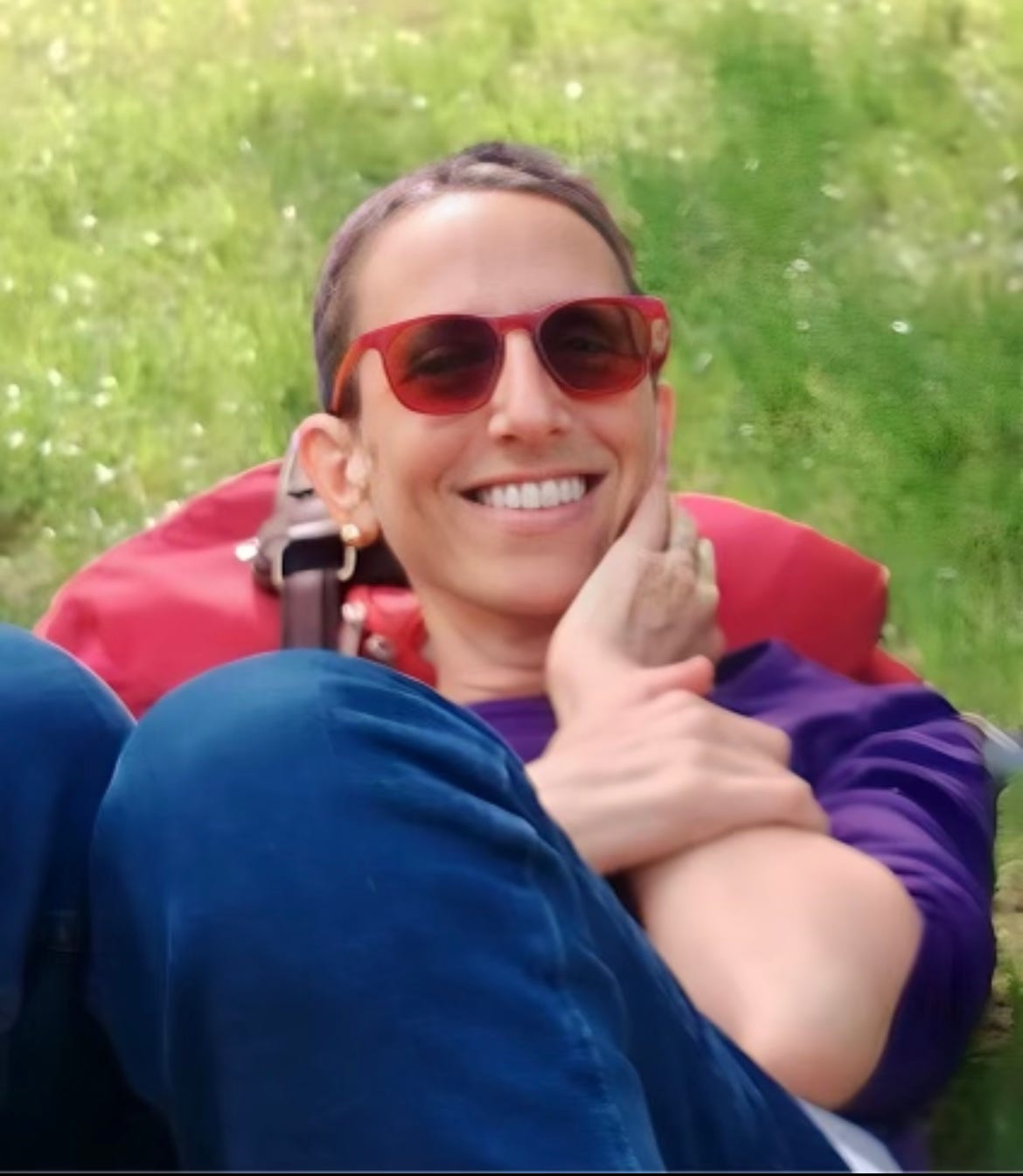
About the author: Jennifer Margulis, Ph.D., is an award-winning science journalist and book author. She has a B.A. from Cornell University, an M.A. from the University of California at Berkeley, and a Ph.D. from Emory. Internationally known as a writer who is not afraid to stick her neck out, Dr. Margulis has appeared live on prime-time television in France to champion an end to child slavery, taught first-generation college students in inner-city Atlanta, and served as a fellow at the Schuster Institute for Investigative Journalism at Brandeis University. Support medical freedom and independent journalism by becoming a paid subscriber to Vibrant Life. Or buy Dr. Margulis a cup of coffee via Venmo: @Jennifer-Margulis-2.
In my small town, these are all nice people. They meant well. We got along. It was OK that they weren't quite as smart as me, or as educated. I was used to it. I didn't judge their little crazy, irrational parts. I tried to see the beauty and intelligence in everyone. But it's all different now because I keep remembering how they treated me when I did not embrace their superstitions. I don't know how to be in relationship with that.
If that is a recent photograph of you taken after your surgery, it is nice to see you looking well and smiling.