
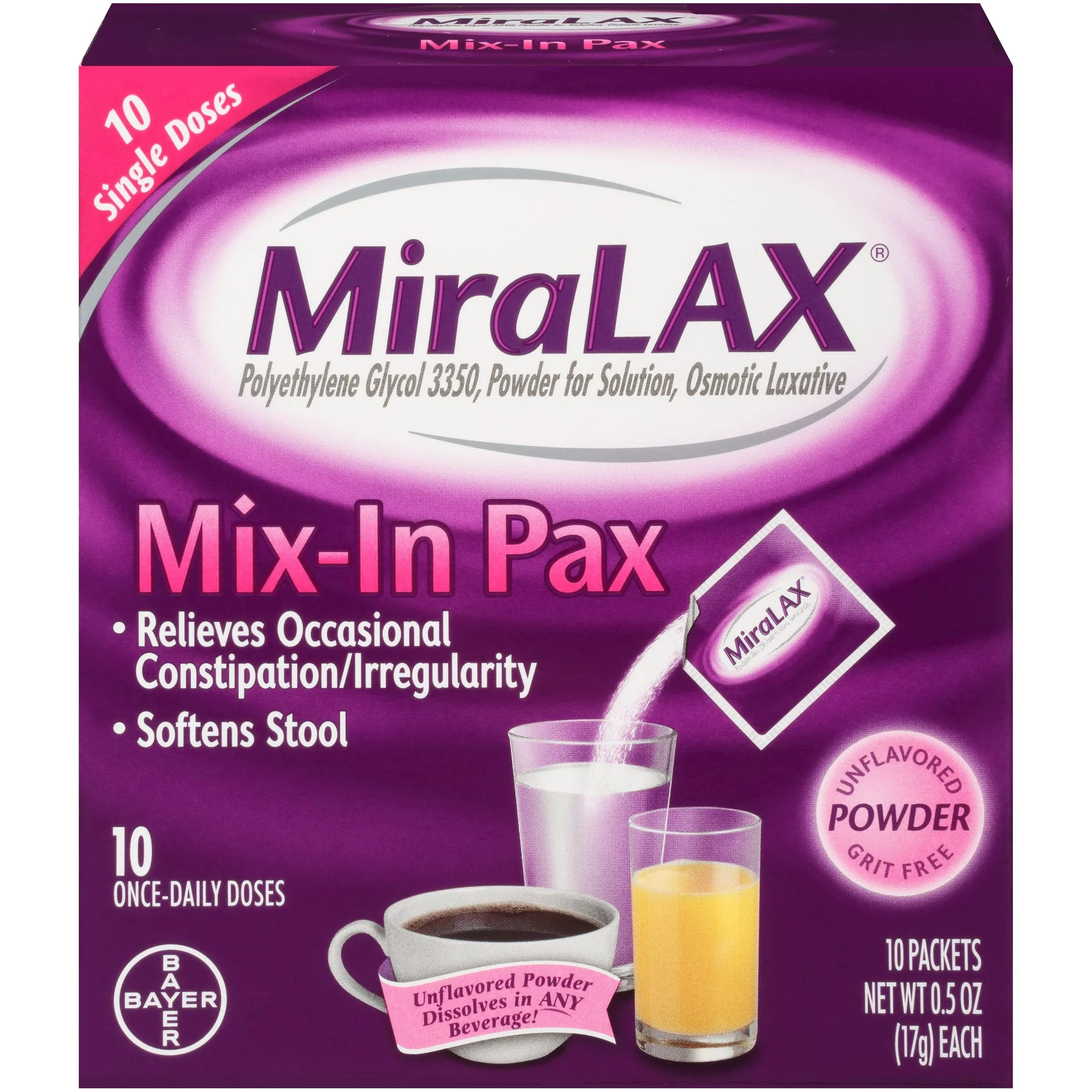
Mike Koehler, who lives in Mount Horeb, Wisconsin, where he runs a small staffing company, took his son to see a urologist when Bradley was four years old. Bradley, who was potty trained, had inexplicably started wetting the bed.
The urologist at the University of Wisconsin’s children hospital, determined that Bradley was severely constipated.
The impacted stool was applying pressure on his bladder, which was what was causing the bed-wetting.
This, Koehler told me over email, is when his family’s MiraLAX journey began.
What is MiraLAX?
MiraLAX is a laxative to help people suffering from constipation.
It works by increasing water in the intestines, which in turn stimulates bowel movements.
While it is supposed to be used for short-term constipation, doctors will also prescribe it for chronic constipation.
I was given MiraLAX when I was hospitalized for ocular melanoma.
I did not have food or water for nearly six days and not had a bowel movement. It comes in a powdered form, which is mixed with either juice or water.
A nurse brought it to me in a small plastic cup. It felt gritty going down but had no noticeable flavor.
The stool I passed after drinking down the MiraLAX was dark brown, foul-smelling, and nearly liquid.
Who is MiraLAX for?
The label on MiraLAX clearly indicates that the product is intended for patients who are 17 years of age or older.
According to the manufacturers, this drug should not be used for children. And should not be used for more than seven days.
But when the urologist recommended this over-the-counter medication for Mike Koehler’s son Bradley, he did not tell him that the drug is not approved for use in children. Bradley took MiraLAX for almost five years.

Devastating side effects
Bradley had been a typical child who seemed to be developing normally, despite his health challenges, until the very end of second grade.
“It was really third grade when the wheels were falling off the bus,” Koehler explained to me in an email, a time that he describes as “nothing short of a nightmare.”
His son became out of control: hitting other kids, pushing them out of line, being defiant, and refusing to do his homework.
No idea where these behavior issues were stemming from, Koehler read a New York Times article on January 6, 2015 from his son’s hospital room. Despite taking MiraLAX, Bradley was still having severe gastrointestinal issues and he was in the hospital for a cleanse to relieve impaction. He was also diagnosed with temporal lobe epilepsy, so the doctors wanted to do a brain scan to see if he was having seizures.
The article, “Scrutiny for Laxatives as a Childhood Remedy,” explained that the FDA had questions about the safety of MiraLAX. A team of scientists in Philadelphia were looking more closely at the drug’s active ingredient, polyethylene glycol 3350 or PEG 3350.
It specified that the FDA had never tested whether PEG could be absorbed into a child’s intestines, and that the agency had received reports of the laxative provoking tremors, tics, obsessive-compulsive behavior and other psychiatric disorders in children.
Moreover, when the FDA had tested eight batches of MiraLAX, the agency found traces of two ingredients in antifreeze, ethylene glycol and diethylene glycol, both highly toxic chemicals, in all of them.
Though that testing had taken place seven years earlier, the results had never been disclosed.
Though after reading the New York Times article Mike Koehler and his wife tried to object, the GI team at the hospital convinced them that the doctors needed to give their son Golytely, another laxative, which contains 236 grams of polyethylene glycol 3350, the exact same ingredient in MiraLAX, as well as electrolytes, via a feeding tube.
In the nine days that followed, Bradley had more than twenty seizures. The connection between his severe health problems and the drug the doctors had given him to “help,” was now clear.
What does the science say?
Why does this laxative appear to harm some children so severely?
What’s going on?
Although there is a growing body of scientific evidence to help explain the mechanisms by which this drug may be causing damage, these are questions that are still under debate.
PEG is a long-chain polymer of ethylene oxide.
It could be that the most harm is coming from the toxic chemicals that are byproducts of the manufacturing process used to make pharmaceutical-grade PEG 3350.
According to an industry report released in June of 2022, these chemicals include formaldehyde, ethylene glycol, and diethylene glycol.
Another hypothesis is that exposure to PEG destroys beneficial gut bacteria which, in turn, can harm both the gut and the brain.
A peer-reviewed paper published in 2017 found that when the microbiome is disrupted following surgical complications, pathogenic bacteria can thrive, causing severe infections, and even death.
In 2018 Stanford University scientists found that exposure to PEG lead to a loss of beneficial bacteria in the gut in as little as three days.
In a 2021 paper, a team of Ohio-based scientists found that exposure to PEG alters the microbiome in rodents, though they did not find evidence that it changed the mice’s behavior.
Earlier research has shown that PEG 3350 exposure leads to a reduction in bile salts in laboratory rats, in addition to destroying beneficial bacteria.
This suggests PEG 3350 exposure may cause damage to the liver.
In 2006, when MiraLAX became more widely available as an over-the-counter drug, Dr. Karen Feibus, M.D., a clinical reviewer for the F.D.A., documented her concern that:
“PEG inhibited most of the metabolic activities of the fecal flora, and this was evidenced by decreases in total short chain fatty acids, butyrate, acetate and fecal bacteria mass.”
Mike Koehler wonders if it was the depletion of the short-chain fatty acid, butyrate, that caused his son’s psychosis.
As Harvard researcher Elizabeth M. Sajdel-Sulkowska, found in a 2021 paper published in the journal Biomedical Research International, short-chain fatty acid deficiency is “associated with brain inflammation, considered a cardinal feature of neuropsychiatric disorders.”
Facebook group: Parents Against MiraLAX
Parents Against MiraLAX is a Facebook group with over 85,000 members. In that forum, parents discuss how to reduce constipation without using potentially toxic drugs, as well as how to resolve the sometimes devastating side effects some children experience from taking it.
After joining that group, Koehler found a naturopath in Madison, Wisconsin who tested his son. A stool analysis showed that Bradley had no lactobacillus, a highly beneficial bacteria, in his stool.
Following a natural protocol to restore his gut bacteria and support his brain and immune function yielded immediate improvements. Bradley’s dysgraphia disappeared, his anxiety started lessening, and his OCD went away.
The improvements were remarkable.
Bradley has been seizure-free since 2018 and has recently stopped taking all pharmaceutical medications. He is eighteen years old now—a senior in high school—and doing great.
“I now know that MiraLAX eradicates bacteria leading to a deficiency in the production of short chain fatty acids and neurotransmitters,” Koehler said. “The short-chain fatty acids are important to regulate inflammation, the constant state of inflammation led to the production of pro-inflammatory cytokines, which is probably what caused the diagnosis of temporal lobe epilepsy.”
Since finding out about the dangers of MiraLAX, the family has assiduously avoided any products containing PEG.
Aside from its toxicity, using MiraLAX may be misguided for another reason: laxatives will sometimes fix the constipation, but they don’t address the reasons a child or an adult is getting impacted bowels in the first place.
“There are so many other ways to address the issue of constipation,” said retired nurse practitioner Lyn Redwood, who has been a health care provider for over three decades.
“By giving these children a laxative, doctors are avoiding identifying and treating the root causes of the constipation and just treating the symptoms.”
About the author
Jennifer Margulis, Ph.D., is an award-winning investigative journalist and book author. A Fulbright grantee and sought-after speaker, she is internationally known as a science-forward journalist whose work helps expose how corporate greed and for-profit medicine sometimes harm human health. She has championed the rights of children on prime-time television in Paris, France; taught post-colonial literature to non-traditional students in Atlanta, Georgia; and appeared as an extra in a movie starring Natalie Portman and Julianne Moore. Support independent journalism by buying her a cup of coffee via Venmo (@Jennifer-Margulis-2) or becoming a paid subscriber to this Substack channel, Vibrant Life.
Related articles
Do mRNA Vaccines Have a Polyethylene Glycol Problem?
How Big Medicine Eats Its Own Young
3 Words You Should Never Say to Someone With an Acute or Chronic Illness
apparently PEG is in almost every shampoo, conditioner, soap, cosmetic food etc. I started getting rashes and after a long process of research found it’s the polyethylene glycolic doing it. Then comes my appointment for a colonoscopy. I’m told I need to take miralax and I just happen to see the ingredients PEG. Unbelievable I already know I’m having reactions to this ingredient on my outside skin and now I’m told it’s safe to take internally. No, no, no. So I tell my dr and pharmacist who I need to convince. So unbelievable I was able to take a magnesium substitute but that’s my last test. How can we trust drs when they are so ignorant of toxic substances. They’ve made it so you can only afford Pharma medicine and not natural medicine that gets to the root of the problem. It’s not covered by insurance. I’m an older woman so disgusted with our medical system. What to do? Carol
The other common use of this is with seniors who go in for any medical procedure. Can't have any poo in the gut when doing surgery. There is a link between Miralax and cognitive decline. Dr'.s have no idea what miralax does to the gut, but give it to all the patients and patients obey to their own detriment.
I would also bet this plays a role in the allergic response to PEG in many people.